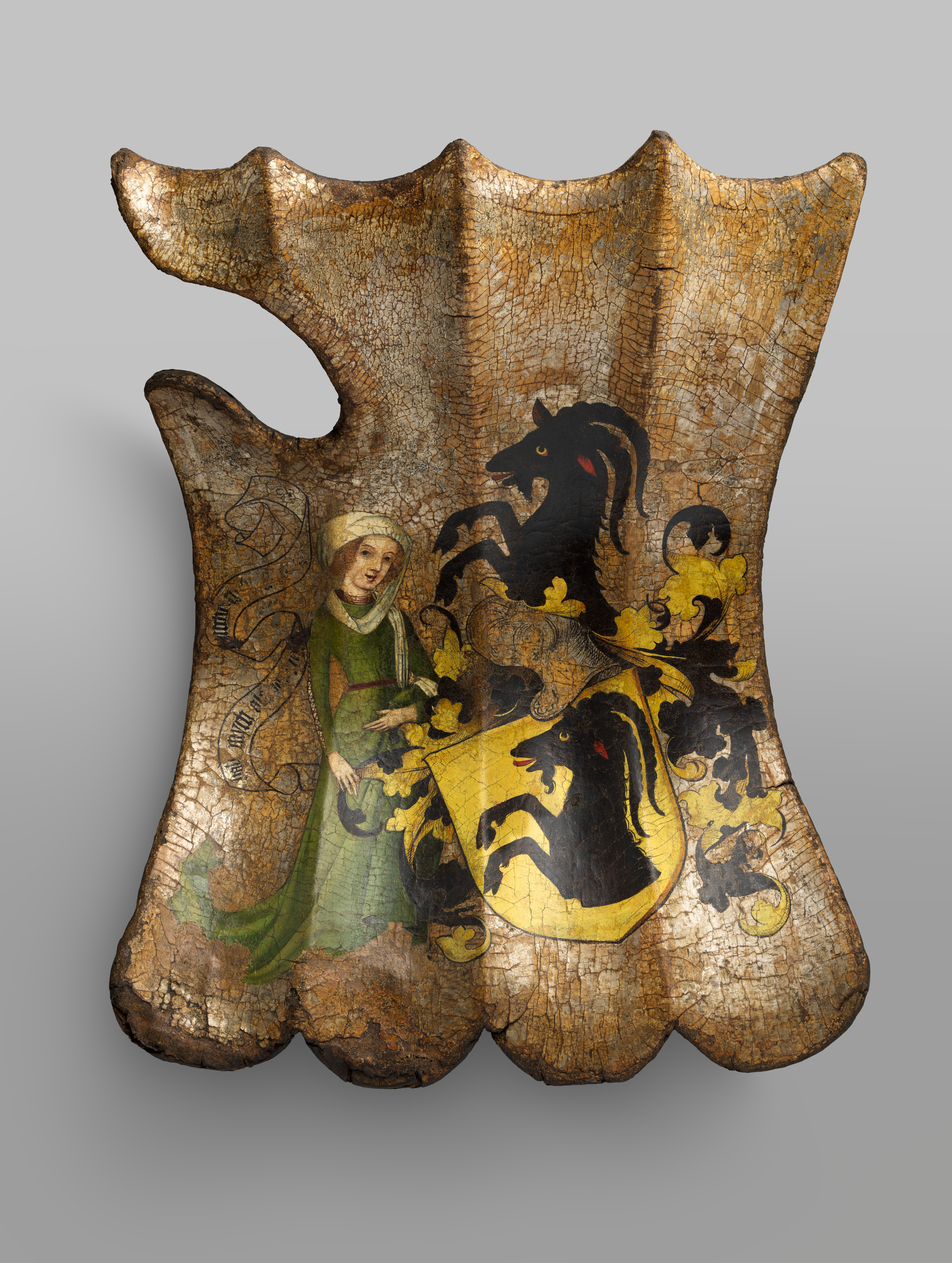
← The object-study collection Left object Shield for the Field or Tournament (Targe) · 25.26.1 Heraldic Shield · 12.137.2 Angels presenting the arms of Halewyn impaling Van Ghistele · 14.40.697d Plate with Arms of the Vitelleschi Family · 1950.155 Bookplate: Coat of Arms with Thomas Cary inscribed below · 1918.149 Seal Impression, Coat of Arms · 1981.534.7 Seal Matrix · 1981.291 Simon de Varie Kneeling in Prayer · 85.ML.27.2 Armor for Man and Horse with Völs-Colonna Arms · 1964.88 Coat of Arms with a Skull · 1953.9 Millefleurs Tapestry with Medici Coat of Arms · 1942.824 Heraldic Roundel with Arms of the Canton of Zürich · 1955.71 Plate with Arms of the Pucci Family · 1942.625 Morion of the State Guard of Elector Christian I of Saxony · 1916.1516 Banner with a Quartered Royal Arms of Spain and the Madonna and Child · 1916.1885 Hours of Charles the Noble, King of Navarre (1361-1425): fol. 137r, Coat of Arms of Charles the Noble · 1964.40.137.a Half Pound: Elizabeth I (obverse); Crowned Shield of Arms (reverse) · 1969.186 Hours of Queen Isabella the Catholic, Queen of Spain: Fol. 1v, Arms and Mottoes of Isabel la Católica · 1963.256.1.b Lord Chancellor's Burse (Purse) with Royal Cypher and Coat of Arms of George III · 1916.1366 Arms of Ueberlingen · 1953.283 Banner with Royal Coat of Arms of Great Britain · 1916.1548 Four-color Velvet with Medici Armorial in Rosettes · 1943.67 Lampas with heraldry of Castile and León, from a royal Christian robe · 1939.48 Gold-patterned Silk with Falcons and Heraldry · 1943.283 Heraldic Panel with Arms of Lichtenfels and a Unicorn Hunt · 1954.149 Heraldic Panel Depicting a Knight and a Lady with the Arms of the Archduchy of Austria · 1955.72 The Arms of Heinrich Bodmer of Baden · 1954.150 Beaker (Humpen) · 1948.232 Panel from a Choir Stall · 1977.74 Teapot · 1958.212 Ichikawa Monnosuke II as a Lord Holding a Banner · 1974.81 Heraldic Lion · 1982.146 St. George’s Chapel: Bain News Service photograph · LC-B2-4463-12; digital ID ggbain.26050 St George’s Chapel, Windsor Castle: colour photograph, 1983 · Flickr photograph 41181845160 Chapel of St Michael and St George, St Paul’s Cathedral, looking east · Wikimedia Commons file 33156317 The Heraldic Achievements of the Grenville, Temple Nugent, and Chandos Families · SS.51 Bayeux Tapestry: scene 51, Norman knights and archers · Wikimedia Commons file 25450703 Banner (Nobori) · 1999.247.6 Tsukudajima sumiyoshi no matsuri — Sumiyoshi festival, Tsukudajima · LC-DIG-jpd-02949 Right object Shield for the Field or Tournament (Targe) · 25.26.1 Heraldic Shield · 12.137.2 Angels presenting the arms of Halewyn impaling Van Ghistele · 14.40.697d Plate with Arms of the Vitelleschi Family · 1950.155 Bookplate: Coat of Arms with Thomas Cary inscribed below · 1918.149 Seal Impression, Coat of Arms · 1981.534.7 Seal Matrix · 1981.291 Simon de Varie Kneeling in Prayer · 85.ML.27.2 Armor for Man and Horse with Völs-Colonna Arms · 1964.88 Coat of Arms with a Skull · 1953.9 Millefleurs Tapestry with Medici Coat of Arms · 1942.824 Heraldic Roundel with Arms of the Canton of Zürich · 1955.71 Plate with Arms of the Pucci Family · 1942.625 Morion of the State Guard of Elector Christian I of Saxony · 1916.1516 Banner with a Quartered Royal Arms of Spain and the Madonna and Child · 1916.1885 Hours of Charles the Noble, King of Navarre (1361-1425): fol. 137r, Coat of Arms of Charles the Noble · 1964.40.137.a Half Pound: Elizabeth I (obverse); Crowned Shield of Arms (reverse) · 1969.186 Hours of Queen Isabella the Catholic, Queen of Spain: Fol. 1v, Arms and Mottoes of Isabel la Católica · 1963.256.1.b Lord Chancellor's Burse (Purse) with Royal Cypher and Coat of Arms of George III · 1916.1366 Arms of Ueberlingen · 1953.283 Banner with Royal Coat of Arms of Great Britain · 1916.1548 Four-color Velvet with Medici Armorial in Rosettes · 1943.67 Lampas with heraldry of Castile and León, from a royal Christian robe · 1939.48 Gold-patterned Silk with Falcons and Heraldry · 1943.283 Heraldic Panel with Arms of Lichtenfels and a Unicorn Hunt · 1954.149 Heraldic Panel Depicting a Knight and a Lady with the Arms of the Archduchy of Austria · 1955.72 The Arms of Heinrich Bodmer of Baden · 1954.150 Beaker (Humpen) · 1948.232 Panel from a Choir Stall · 1977.74 Teapot · 1958.212 Ichikawa Monnosuke II as a Lord Holding a Banner · 1974.81 Heraldic Lion · 1982.146 St. George’s Chapel: Bain News Service photograph · LC-B2-4463-12; digital ID ggbain.26050 St George’s Chapel, Windsor Castle: colour photograph, 1983 · Flickr photograph 41181845160 Chapel of St Michael and St George, St Paul’s Cathedral, looking east · Wikimedia Commons file 33156317 The Heraldic Achievements of the Grenville, Temple Nugent, and Chandos Families · SS.51 Bayeux Tapestry: scene 51, Norman knights and archers · Wikimedia Commons file 25450703 Banner (Nobori) · 1999.247.6 Tsukudajima sumiyoshi no matsuri — Sumiyoshi festival, Tsukudajima · LC-DIG-jpd-02949 Swap objects ⇄
Gift of Mrs. Florence Blumenthal, 1925 · CC0 . Resized without cropping or recolouring.
German
Shield for the Field or Tournament (Targe)
Catalogue date ca. 1450
Material Wood, leather, linen, gesso, pigments, silver
Catalogue maker Not specified in this study
Repository The Metropolitan Museum of Art
Accession 25.26.1 A painted targe carries a smaller armorial shield. Reading the two separately helps us understand the object without settling its disputed family attribution.
General Income Fund · CC0 . Resized without cropping or recolouring.
America, late eighteenth–early nineteenth century
Bookplate: Coat of Arms with Thomas Cary inscribed below
Catalogue date 1766–1821 (catalogue range)
Material Engraving
Catalogue maker Joseph Callender
Repository Cleveland Museum of Art
Accession 1918.149 An American engraving connects an armorial image to a printed name while leaving the history of this particular impression open.
✦ Make your evidence explicit
The research notebook. Notes are saved in this browser for each ordered pair. Keep a copy by exporting them with the objects’ identifiers and source links.
Choose your objects and begin with a question.
Export notes ↓ Copy notes Copy comparison link
The initial comparison and research prompts are readable without JavaScript. Interactive object selection, saving, and export require JavaScript; you can keep notes in your own document.
✦ Before you draw a conclusion
Explain the resemblance before relying on it. Describe the support. Is this a physical shield, a vessel, glass, enamel, or a printed impression? Identify what the photograph actually shows.Separate the voices. Mark which statements are your observations and which are the museum’s date, identification, or attribution.Compare like with like. A maker attribution, family identification, and object provenance answer different questions. A shared charge does not establish a shared owner or workshop.Propose a test. Name a dated source that could support or contradict your explanation. Record uncertainty while that evidence remains unavailable.Continue to the source-criticism seminar ↗