✦ Anglo-Norman narrative; makers unrecorded · 11th century; Photograph: 7 March 2013
A battle before the armorial directory
An embroidered battle scene makes shields, bodies, weapons, and words work together. It offers a powerful comparison with later heraldry without turning every shield pattern into a hereditary coat of arms.
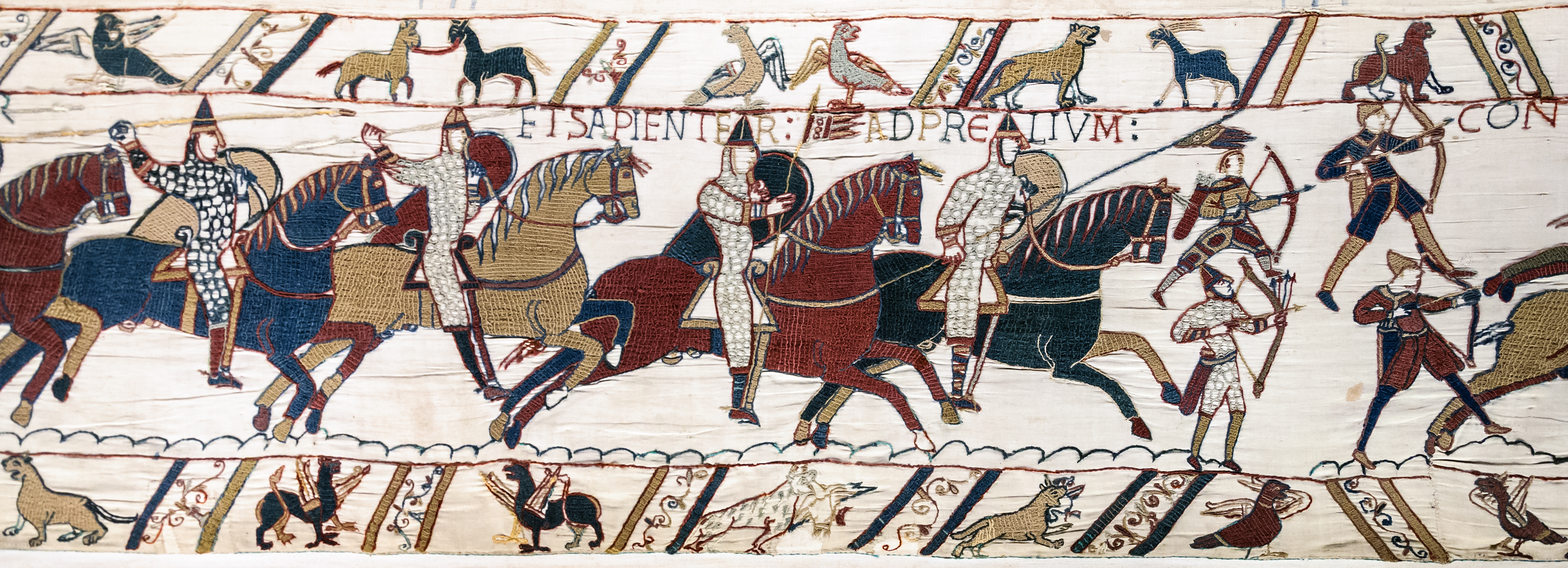
Myrabella / Wikimedia Commons / CC0 · Public domain. Resized without cropping or recolouring.
Enlarge the photograph ↗✦ Photograph-based observations
How many ways can a picture identify an army?
Mounted figures advance across the central strip beside archers on foot. Long shields, patterned clothing, horses, bows, and raised weapons distinguish bodies and actions. A line of lettering runs above them.
Animal and human figures occupy the narrower borders. The central action and the border imagery share a stitched surface but operate at different scales. This photograph shows a selected section rather than the entire narrative.
What the record tells us
Bayeux Museum explains that the work commonly called a tapestry is wool embroidery on linen. Its institutional account places the work in the eleventh century, leaves its makers unknown, and presents Bishop Odo of Bayeux as the probable commissioner. This separately licensed photograph by Myrabella records the detail catalogued on Commons as scene 51 on 7 March 2013. [1]
✦ Editorial interpretation
What follows from the arrangement?
The first thing to read is the action. Mounted warriors, archers, weapons, text, and direction organize a scene that identifies roles through several channels at once. Shield decoration belongs to that larger arrangement. If we remove a single shield and place it in a modern armorial chart, we discard the contextual information that made it intelligible within the embroidery. The isolated pattern may look heraldic while the historical argument needed to call it hereditary armory remains unmade.
That is a productive problem rather than a reason to ignore the shields. Record the visible designs and compare appearances across the narrative. Does a particular pattern recur with a named person? Does it remain stable when the person changes position or equipment? What can be learned from repetition, and what might instead reflect workshop convention or the requirements of the scene? Those questions let the embroidery contribute to a history of identification without requiring it to behave like a later roll of arms.
The picture is also an account of a conflict made after the events it represents. Its narrative choices deserve examination alongside its material construction. A named figure or a represented gesture tells us how the story was presented; confirming the corresponding historical act calls for comparison with other witnesses. This distinction becomes especially useful when an arresting image seems to settle an argument all by itself. A vivid embroidery can supply excellent evidence for its own account while leaving the event behind that account open to inquiry.
Compare this scene with a later heraldic banner. Both use cloth, colour, and a public audience, but the identifying work is distributed differently. A banner of arms can make a stable armorial design its central content. Here the scene relies on bodies, equipment, direction, and lettering as well as shield patterns. Following that difference helps explain the emergence of heraldic identification as a particular solution within a much longer history of visible signs.
Claims and their evidence
| Claim | Evidence | Limit |
|---|---|---|
| The work is embroidery on linen rather than a woven tapestry. | Bayeux Museum’s material explanation | The photograph does not independently determine the fibres or every stitch. |
| The photograph records scene 51 on 7 March 2013. | Individual Commons photograph record | Not the date of the embroidery or evidence of its present display location. |
| Shield patterns participate in the scene’s identification system. | Visible photographed detail | Their appearance alone does not establish stable hereditary coats or entitlement. |
✦ Your turn
Explain what supports your conclusion.
Make an inventory of five means of identification or narrative distinction in this detail. Then isolate one shield pattern and formulate a test for the proposition that it identifies a particular bearer consistently. State what evidence would strengthen that proposition and what would leave it unresolved.
Discuss your answer
An effective inventory includes posture, equipment, direction, lettering, and decoration, rather than treating shield patterns as the only meaningful signs. The proposed test looks for dated or internally repeated associations with an identifiable bearer. A resemblance to a later coat is a research lead; it needs an argument connecting the witnesses.
Take the research further
Follow the museum’s account of manufacture and narrative, then compare this selected detail with its online guide. Investigate how a named person is identified across multiple scenes. Preserve the difference between an eleventh-century representation, the battle it narrates, and the 2013 photograph.
Return to the related Academy reading ↗Sources and image rights
- Bayeux Museum, Making the Bayeux Tapestry. Record consulted 2026-10-11. The date above describes the artifact or photograph, not the publication date of this webpage.
- Public domain — image rights. The individual file record dedicates Myrabella’s 2013 photograph under CC0 and records the historic embroidery as public domain. This is that separately licensed photograph, not an extraction from the museum’s restricted 2017 digital panorama. A source-generated preview is reproduced without local cropping or recolouring. Image credit: Myrabella / Wikimedia Commons / CC0. Photograph’s source and rights record ↗
- Bayeux Museum, What is the Bayeux Tapestry about?. Institutional explanation of the represented narrative; the events of the story and the surviving embroidered witness need separate evaluation. Consulted 2026-10-11.

Show the BibTeX citation
@misc{jhheraldry_object-bayeux-tapestry,
  author = {{Bayeux Museum}},
  title = {Making the Bayeux Tapestry (study photograph identifier Wikimedia Commons file 25450703)},
  howpublished = {\url{https://www.bayeuxmuseum.com/en/the-bayeux-tapestry/discover-the-bayeux-tapestry/tapestry-or-embroidery/}},
  url = {https://www.bayeuxmuseum.com/en/the-bayeux-tapestry/discover-the-bayeux-tapestry/tapestry-or-embroidery/},
  note = {Original-language institutional account. Accessed 2026-10-11.}
}